How to Calculate Board Feet: Formula & Examples (2026)
If you’re wondering how to calculate board feet before placing a lumber order, the good news is that it comes down to one simple formula you can do in your head or on the back of a receipt. Board feet is the standard unit lumber yards use to price hardwood and specialty wood, and getting it wrong by even a little can mean overpaying or coming up short mid-project.
This guide walks through the exact formula, worked examples for lumber, logs, and standing trees, real project scenarios like decking and framing, and the most common mistakes that throw off a board footage estimate. When you’re ready to run your own numbers, plug your dimensions into the Lumber Calculator to get an instant board footage and cost total.
What Is a Board Foot?
A board foot (abbreviated bd ft, BF, or FBM) is a unit of volume, not length or area. One board foot equals a piece of wood that is 12 inches long, 12 inches wide, and 1 inch thick — 144 cubic inches total. It’s the standard measurement hardwood dealers and sawmills use because hardwood boards come in random, uneven widths and lengths, unlike the standardized 2x4s and 2x6s sold at a big box store.
The definition itself never changes; only the shape of the wood does. A board that’s 24 inches wide, 6 inches long, and 1 inch thick is still one board foot, just like a 12x12x1 board is — the volume is identical even though the dimensions look completely different.
The Board Foot Formula
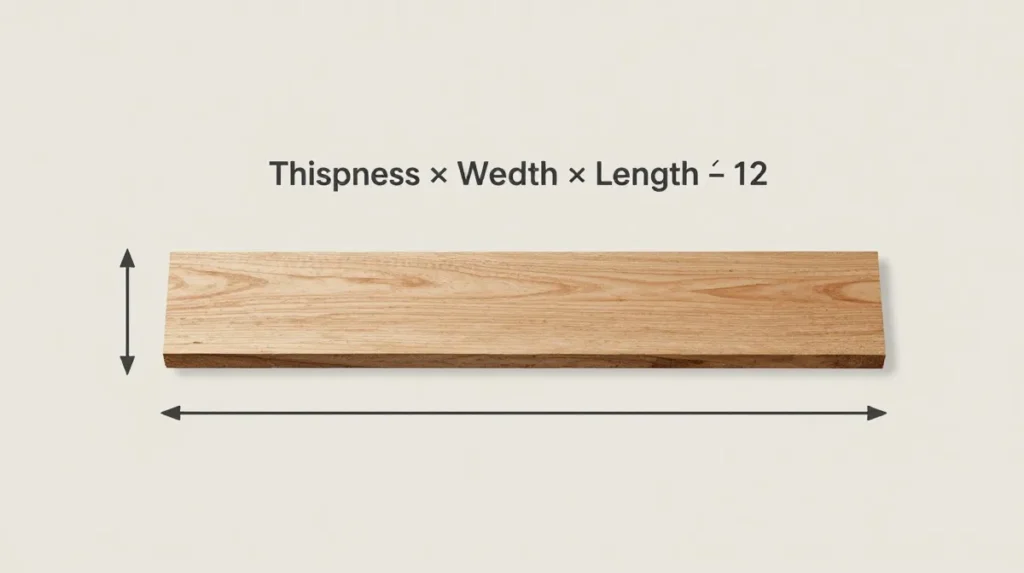
There are two versions of the formula depending on whether you’re measuring length in feet or inches. Both give you the same answer.
If length is in feet:
Board Feet = (Thickness in. × Width in. × Length ft.) ÷ 12
If length is in inches:
Board Feet = (Thickness in. × Width in. × Length in.) ÷ 144
Always use the lumber’s nominal dimensions (the size it’s labeled as before drying and planing), not the smaller actual dimensions. A “1-inch” hardwood board is treated as a full inch thick for board footage purposes, even though it may measure closer to 13/16″ after milling.
How to Calculate Board Feet in Lumber (Step-by-Step)
Here’s how to calculate board feet for a single piece of lumber, step by step:
- Measure the thickness of the board in inches (use nominal thickness, e.g., a 4/4 board = 1″).
- Measure the width of the board in inches.
- Measure the length of the board in feet (round up to the nearest whole foot for dimensional lumber).
- Multiply thickness × width × length.
- Divide by 12 to get the board feet for that piece.
- Repeat and add up every piece in your cutting list to get your project total.
Worked example: Say you’re calculating board feet for lumber that measures 2 inches thick, 6 inches wide, and 10 feet long.
BF = (2 × 6 × 10) ÷ 12 = 10 board feet
Multiple pieces example: Now say your project needs five pieces of 2″x8″ hardwood, each 12 feet long.
BF per board = (2 × 8 × 12) ÷ 12 = 16 board feet Total = 16 × 5 = 80 board feet
| Board Size (T x W x L) | Formula | Board Feet |
|---|---|---|
| 1″ x 6″ x 8′ | (1×6×8)/12 | 4.0 |
| 1″ x 12″ x 8′ | (1×12×8)/12 | 8.0 |
| 2″ x 4″ x 8′ | (2×4×8)/12 | 5.33 |
| 2″ x 6″ x 10′ | (2×6×10)/12 | 10.0 |
| 2″ x 8″ x 12′ | (2×8×12)/12 | 16.0 |
| 4″ x 4″ x 8′ | (4×4×8)/12 | 10.67 |
How to Calculate Board Feet in a Log
Calculating the board feet in a log is different from calculating it for milled lumber because you’re estimating how much usable lumber a round log will yield once it’s sawn — not measuring a finished board. Sawmills and log buyers use log scaling rules for this, and the most common in the U.S. is the Doyle scale.
Doyle log rule formula:
Board Feet = ((Diameter − 4)² × Length) ÷ 16
Where diameter is the small end of the log measured in inches inside the bark, and length is the log length in feet.
Worked example: A log with a small-end diameter of 20 inches and a length of 16 feet:
BF = ((20 − 4)² × 16) ÷ 16 = (256 × 16) ÷ 16 = 256 board feet
The Doyle scale tends to underestimate yield on smaller logs, which is why log buyers commonly favor it — but it gets more accurate as log diameter increases. Two other rules, the Scribner and International ¼-inch rules, are also widely used and tend to run closer to actual mill yield, especially on smaller-diameter logs. All three rules date back more than a century and can differ meaningfully from actual milled volume depending on log size, according to U.S. Forest Service research comparing log scaling methods. If you’re buying or selling logs regularly, ask which scale the mill uses before comparing quotes — the same log can produce very different “official” board footage depending on the rule applied.
How to Calculate Board Feet in a Tree (Standing Timber)
To estimate board feet in a standing tree, foresters measure two things: the tree’s diameter at breast height (DBH, measured 4.5 feet off the ground) and its merchantable height (the usable trunk length before it branches out or becomes too small to mill). Those two numbers are then cross-referenced against a volume table built on one of the log scaling rules above, most commonly Doyle.
This isn’t something you can do precisely with a tape measure alone — a tool called a Biltmore stick is typically used to estimate diameter and height from a fixed distance without climbing or felling the tree. Because standing timber estimates involve taper, defects, and species-specific yield differences, they’re best treated as an approximation for budgeting purposes rather than an exact number, and a professional forester’s cruise is the only way to get a figure you can rely on for a timber sale.
How to Calculate Board Feet Price
Once you know your total board footage, pricing is one more multiplication step:
Total Cost = Total Board Feet × Price per Board Foot
Example: If your project needs 80 board feet and the hardwood you’ve chosen costs $4.15 per board foot:
80 × $4.15 = $332.00
A few pricing notes worth factoring in before you check out:
- Add a waste buffer. Most builders add 10–15% extra board footage to account for defects, warped boards, and cutting mistakes.
- Compare species and grades. Board foot pricing varies significantly by species (walnut and cherry run far higher than poplar or pine) and by grade (FAS vs. No. 1 Common).
- Confirm minimum board foot purchases. Some yards have a minimum order, which can change your effective price per board foot on small projects.
For a full material cost breakdown across your whole build — lumber, concrete, fasteners, and more — run your numbers through the Raw Material Cost Calculator.
Board Feet for Common Building Projects
Here’s how the formula plays out on a few real project types:
| Project | Board Size | Qty | Formula | Total Board Feet |
|---|---|---|---|---|
| Deck boards | 2″ x 6″ x 12′ | 20 | (2×6×12)/12 × 20 | 240 bf |
| Wall framing | 2″ x 4″ x 8′ | 50 | (2×4×8)/12 × 50 | 266.7 bf |
| Cabinet hardwood | 1″ x 6″ x 8′ | 10 | (1×6×8)/12 × 10 | 40 bf |
Calculating board feet for a deck or framing project works exactly the same way as any other lumber calculation — the only extra step is multiplying your per-board total by however many boards your plans call for. If you’re scoping an entire build rather than a single material, the Home Build Cost Calculator rolls lumber costs into your full project budget alongside labor, permits, and other materials.
Board feet for spray foam insulation: Spray foam is sold using the same underlying unit — one board foot is one square foot of coverage at one inch of thickness. To estimate board feet for spray foam insulation, multiply the square footage of the surface by the thickness (in inches) you plan to spray. Example: a 500 sq ft wall sprayed at 2 inches thick needs 500 × 2 = 1,000 board feet of foam.
Board Feet vs. Linear Feet vs. Square Feet
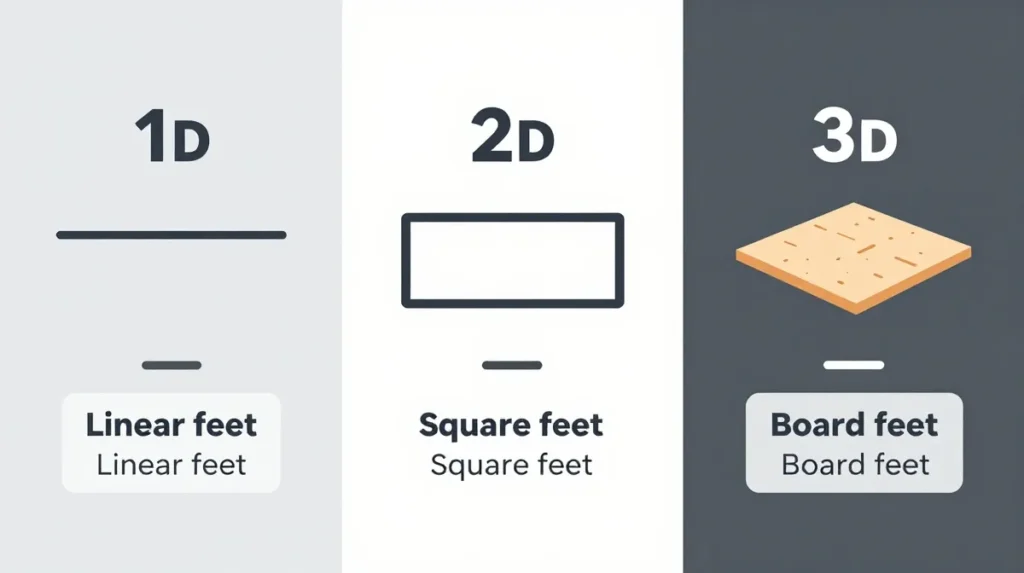
These three units get mixed up constantly, but each measures a different dimension:
| Unit | Measures | Formula | Used For |
|---|---|---|---|
| Linear Feet | Length only (1D) | Length (ft) | Trim, molding, fencing, uniform-dimension lumber |
| Square Feet | Area (2D) | Length × Width (ft) | Flooring, siding, sheet goods, material under 1″ thick |
| Board Feet | Volume (3D) | (T × W × L) ÷ 12 | Hardwood, rough-sawn lumber, random-width stock |
The quickest way to remember it: linear feet ignores width and thickness entirely, square feet ignores thickness, and board feet accounts for all three dimensions. If you regularly convert between square footage and linear footage for trim or flooring takeoffs, that’s a separate calculation worth bookmarking once you’ve got board feet down.
Common Mistakes When Calculating Board Feet
- Using actual dimensions instead of nominal. A “2×4″ is really 1.5″ x 3.5″ after milling, but board foot math uses the nominal 2″ x 4”.
- Mixing units. Forgetting to convert length to feet (or width/thickness to inches) throws the whole formula off — double-check which version of the formula you’re using.
- Confusing board feet with square feet. Lumber under 1″ thick is typically priced and measured in square feet, not board feet.
- Skipping the waste factor. Ordering exactly what the formula says, with no buffer for defects or mistakes, is one of the most common reasons builders run short mid-project.
- Rounding too early. Round your final board footage, not each individual measurement, to avoid compounding small errors across a large cutting list.
Key Takeaways
- A board foot is a unit of volume: 12″ long × 12″ wide × 1″ thick, or 144 cubic inches.
- The core formula is (Thickness in. × Width in. × Length ft.) ÷ 12.
- Always use nominal, not actual, lumber dimensions.
- Logs and standing trees use scaling rules like the Doyle scale, not the standard board formula.
- Board feet ≠ linear feet ≠ square feet — each measures a different dimension of the wood.
- Add a 10–15% waste buffer to your total before ordering.
- Use the Lumber Calculator to skip the manual math and get an instant board footage and cost estimate.
Frequently Asked Questions
What is a board foot in simple terms? A board foot is a unit of wood volume equal to a board 12 inches long, 12 inches wide, and 1 inch thick — 144 cubic inches. It’s used to measure and price rough and hardwood lumber.
How many board feet are in a 2x4x8? A nominal 2″x4″x8′ board equals (2 × 4 × 8) ÷ 12 = 5.33 board feet.
How do you calculate board feet in a log? The most common method is the Doyle log rule: ((Diameter − 4)² × Length) ÷ 16, using the log’s small-end diameter in inches (inside the bark) and length in feet.
Is a board foot the same as a linear foot? No. A linear foot only measures length, while a board foot measures volume (length, width, and thickness combined). A 10-foot 2×4 is 10 linear feet but only 6.67 board feet.
How do you calculate board feet for spray foam insulation? Multiply the square footage of the surface by the thickness in inches you’re spraying. A 500 sq ft area at 2″ thick equals 1,000 board feet of foam.
Why is lumber priced by the board foot instead of just by length? Because hardwood boards come in random, uneven widths and thicknesses, price-per-length wouldn’t account for how much actual wood is in each piece. Board footage standardizes pricing based on true volume — the same principle behind the grading and measurement rules maintained industry-wide by the National Hardwood Lumber Association.
Data Sources
| Anchor Text | URL | Why |
|---|---|---|
| U.S. Forest Service research comparing log scaling methods | https://research.fs.usda.gov/treesearch/55271 | Authoritative, non-competing government source on Doyle/Scribner/International log rule accuracy |
| National Hardwood Lumber Association | https://www.nhla.com/services/nhla-grading-rules | Authoritative, non-competing trade body governing hardwood measurement standards |

Sarah specializes in home renovation budgeting and cost breakdown analysis. She reviews contractor pricing, material specifications, and building material trends across different regions. Her editorial work focuses on ensuring our calculators reflect current market conditions and building practice standards.