Cost to Build a House by State: 2026 Price Breakdown for Every Region
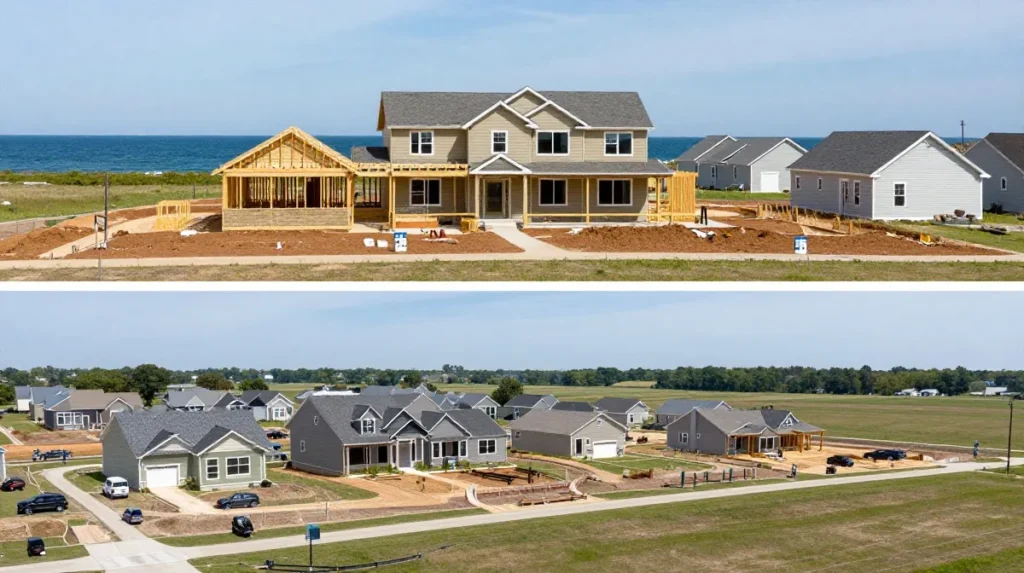
The same 2,000 square foot house can cost $240,000 in one state and $800,000 in another — not because of size or finish level, but purely because of which state line it sits inside. Construction costs now account for a record 64.4% of a new home’s sale price nationally, and state-level data shows as much as a 49–50% swing in cost per square foot between the cheapest and most expensive markets in the country.
This guide breaks that gap down region by region — what drives it, where you get the most house for your money, and where a handful of specific state rules (seismic code, hurricane requirements, energy standards) quietly add tens of thousands to a build regardless of finish level.
Quick answer: Nationally, construction cost runs roughly $150–$300 per sq ft for a standard build, but that hides an enormous range: as low as $90–$150/sq ft in parts of the rural Midwest and Deep South, and $400–$800+/sq ft in premium coastal metros like Los Angeles, San Francisco, and Seattle. Most states fall in a $135–$250/sq ft band for standard construction. See the full state comparison table below, then run your specific state and finish level through the Home Build Cost Calculator for a tailored number.
Why Home Building Costs Vary So Much by State
Labor markets: union vs. right-to-work states
Skilled-trade labor is priced very differently depending on regional union density. States with lower unionization and more flexible wage-setting — much of the South and parts of the Midwest — generally see lower framing, electrical, and plumbing labor costs. States with strong union presence and prevailing-wage requirements, including California, New York, Washington, and much of the Northeast, carry a real labor premium on top of everything else. This isn’t static, either — Michigan repealed its right-to-work law in 2023, a reminder that state labor policy (and its effect on build cost) can shift within a single project’s planning window.
Permit and code complexity by state
Permitting alone can separate two states with similar construction costs. In Seattle, permit fees can run as high as 2% of total project cost, with total permit expenses reaching $26,000 on some projects and processes stretching past 11 months. In North Carolina’s fast-growing Triangle region, permit and impact fees commonly run $5,000–$20,000. Rural markets with lower growth pressure — much of Washington outside Seattle, for instance — can approve permits in as little as 30 days. Complexity and timeline, not just fees, are a real cost driver on their own.
Material transport costs in rural vs. coastal markets
Hawaii is consistently the most expensive state to build in nationally, driven largely by the cost of importing nearly every material by sea. On the mainland, the same logic applies at a smaller scale: coastal and dense urban markets pay a transport and logistics premium that rural markets don’t, while rural markets trade that savings for potentially longer hauls on specialty materials. The gap can be dramatic within a single state — rural Washington markets around Spokane run $150–$210 per sq ft, while Seattle runs $300–$550+ for the same standard construction.
Most Expensive States to Build a House
Cost to build a house in California: why it runs $400–$600+/sq ft
California’s cost range is wide by design — a modest inland home and a custom coastal rebuild are both “California,” but they sit at opposite ends of the spectrum. Statewide, construction runs roughly $200–$280/sq ft for standard builds, but that number breaks down sharply by metro:
- Inland markets (Fresno, Bakersfield, Sacramento): $150–$350/sq ft
- Los Angeles: $400–$600/sq ft for standard-to-custom construction, reaching $750+ for high-end custom
- San Francisco: $500–$800/sq ft, among the most expensive construction markets in the country
The drivers are land, labor, and code: Bay Area land can run $850,000–$950,000+ per acre in prime counties, construction labor costs have risen roughly 21% since 2019, and stringent seismic and wildfire-resistant construction requirements add both material and labor cost that most other states don’t carry.
Washington and Oregon: Pacific Northwest premium drivers
Washington’s statewide average lands around $180–$260/sq ft, but Seattle metro construction runs $300–$550+ for standard builds and can exceed $900/sq ft for high-performance custom homes. Oregon follows a similar pattern — Portland-area estimates range from roughly $110–$500/sq ft depending on source and scope, with custom, high-detail builds starting closer to $600–$900/sq ft. Three factors compound here: land scarcity in urban growth boundaries, a genuinely strict energy code (Washington’s code requires high insulation values, triple-pane windows on many assemblies, heat pump mechanical systems, and heat recovery ventilation), and a skilled-labor shortage that has pushed subcontractor costs up 20–30% since before the pandemic.
New York and New England states: permit and labor burden
New York runs roughly $225–$325/sq ft statewide, with Massachusetts ($215–$295), New Jersey ($210–$290), and Connecticut ($195–$275) close behind. The Northeast’s premium comes from a combination of high union labor rates, dense and often slow zoning/permitting processes, older infrastructure that can complicate site utility connections, and land costs that climb sharply near New York City and Boston.
Mid-Range States: What You Get for $150–$250/sq ft
Cost to build a house in Texas across different metros
Texas averages $162/sq ft including contractor fees, with a broader statewide range of roughly $120–$270/sq ft. A 2,500 sq ft home runs about $405,000 for construction alone; add $30,000–$120,000 for land depending on proximity to Austin, Dallas, Houston, or San Antonio, and total project cost lands between $435,000–$525,000. For the full metro-by-metro breakdown across Texas’s major cities, see our dedicated Texas House Build Cost Guide.
Cost to build a house in Florida by region (Tampa vs. Miami vs. Orlando)
Florida averages $170/sq ft statewide, with a general range of $155–$215/sq ft. Miami commands a real premium over Tampa and Orlando — coastal land cost and hurricane-code requirements (impact-rated windows, wind-rated roofing, elevated foundations in flood zones) both push the number up, while inland Orlando and the Tampa Bay area generally track closer to the state average. See our full regional breakdown in the Florida House Build Cost Guide.
Cost to build a house in NC (North Carolina), Georgia, and the Sun Belt
North Carolina’s builder-grade construction runs $135–$200/sq ft, with custom builds reaching $200–$450/sq ft — putting the state near or slightly below the national average, though the Triangle (Raleigh/Durham/Chapel Hill) and Charlotte metros run 10–15% above the rest of the state due to strong in-migration and tight subcontractor availability. Georgia follows a broadly similar Sun Belt cost profile to North Carolina. Both states are seeing costs drift toward — and in fast-growing metros, past — the national average as population growth outpaces housing supply.
Most Affordable States to Build a House
Cost to build a house in Michigan (plus Ohio and Indiana): the Midwest advantage
Michigan construction cost estimates vary by source, but a reasonable statewide consensus lands around $130–$260/sq ft, with real metro variation — Ann Arbor runs $155–$185/sq ft on University of Michigan-driven demand, Grand Rapids $135–$155, and Flint/Saginaw as low as $100–$120, roughly 20%+ below the national average. Ohio runs a similarly wide $110–$240/sq ft, and Indiana sits at the more affordable end of the Midwest at roughly $145–$205/sq ft.
Iowa, Kansas, and plains states: where cost per sq ft is lowest
Iowa consistently posts among the lowest ranges in the country, roughly $90–$200/sq ft. The broader Plains region shares Iowa’s advantages: cheap land, lower union density, and generally faster permitting timelines than coastal metros, keeping per-square-foot costs at or near the national floor.
Alabama, Arkansas, Mississippi: Deep South pricing
Mississippi, Alabama, and Arkansas consistently rank as the most affordable tier nationally, generally $140–$155/sq ft. Beyond low land and labor costs, climate plays a real role here — Mississippi’s mild winters mean homes are commonly built on slab-on-grade foundations rather than full basements, cutting excavation and concrete costs that colder-climate states can’t avoid.
Cost per Square Foot by State: Comparison Table
Low / mid / high estimate per sq ft for top 20 states
| State | Basic | Standard | Custom/Luxury |
|---|---|---|---|
| Hawaii | $205 | $260 | $380+ |
| California | $200 | $280 | $600+* |
| New York | $225 | $270 | $325+ |
| Washington | $180 | $230 | $350+* |
| Massachusetts | $215 | $255 | $295+ |
| New Jersey | $210 | $250 | $290+ |
| Oregon | $150 | $220 | $350+* |
| Illinois | $185 | $220 | $260+ |
| Texas | $120 | $162 | $270+ |
| Florida | $155 | $170 | $215+ |
| North Carolina | $135 | $180 | $450+ |
| Ohio | $110 | $170 | $240+ |
| Michigan | $130 | $180 | $350+ |
| Indiana | $145 | $175 | $205+ |
| Wisconsin | $155 | $185 | $215+ |
| Iowa | $90 | $145 | $200+ |
| Mississippi | $140 | $150 | $200+ |
| Alabama | $140 | $150 | $200+ |
| Arkansas | $140 | $150 | $200+ |
*Premium coastal metros within these states (Los Angeles/San Francisco, Seattle, Portland) run well above even the “Custom/Luxury” column — see the state sections above for metro-specific figures.
What’s included (and excluded) in these figures
Every figure above covers construction cost only — foundation through interior finishes. None of it includes land, permits, site work, design fees, or financing costs, which is exactly why two “$250/sq ft” quotes from different builders can produce very different final bids: one may already include contractor overhead and profit, the other may not. Always ask a builder to confirm whether GC markup is baked into a quoted per-square-foot number before comparing it against the ranges here.
State-Specific Factors That Move the Number
Hurricane and seismic building code upcharges (FL, CA)
Florida’s hurricane code requires impact-rated windows, wind-rated roofing systems, and elevated foundations in flood zones — all real cost adders concentrated in coastal and South Florida markets. California’s seismic code requires engineered structural reinforcement and specific foundation anchoring statewide, and in wildfire-risk zones, increasingly requires fire-resistant materials and assemblies as well. Neither of these is optional or something a builder can quote around — they’re baked into the code, and into the price.
Energy code stringency and insulation cost implications
States like Washington and California have adopted genuinely strict energy codes — high insulation values, triple-pane windows on many assemblies, mandatory heat pump systems, and heat recovery ventilation in Washington’s case. These requirements raise upfront construction cost but lower long-term utility bills, echoing the same trade-off covered in How to Reduce the Cost of Building a House — a stricter energy code is effectively a mandatory version of the “spend more upfront, save on utilities” calculation, whether or not you’d have chosen it yourself.
HOA and architectural review board delays and costs
Planned communities — common in fast-growing Sun Belt metros across Texas, Florida, North Carolina, and Georgia — often require architectural review board approval before permits can even be pulled, adding weeks to months of timeline. Some boards go further, mandating specific higher-cost materials or finishes to match a community’s design standards. It’s a state-adjacent factor rather than a state rule, but it concentrates heavily in exactly the high-growth states covered in this guide, and it’s a hidden cost worth budgeting for the same way you’d budget for permits and utility hookups.
Frequently Asked Questions
How much does it cost to build a house in Texas? Texas averages $162 per sq ft including contractor fees, with a statewide range of roughly $120–$270/sq ft. A 2,500 sq ft home runs about $405,000 in construction cost alone, plus $30,000–$120,000 for land depending on the metro.
How much does it cost to build a house in Florida? Florida averages $170 per sq ft, generally ranging $155–$215/sq ft. Miami runs above the state average due to coastal land cost and hurricane-code requirements; Tampa and Orlando generally track closer to the statewide figure.
How much does it cost to build a house in Michigan? Michigan construction cost estimates vary, but a reasonable statewide range is $130–$260/sq ft, with meaningful metro variation — Ann Arbor and other high-demand markets run higher, while cities like Flint and Saginaw run well below the state average.
How much does it cost to build a house in California? Statewide construction runs roughly $200–$280/sq ft, but premium coastal metros price far higher — Los Angeles typically runs $400–$600/sq ft and San Francisco $500–$800/sq ft, while inland markets like Fresno and Bakersfield stay closer to $150–$350/sq ft.
How much does it cost to build a house in NC (North Carolina)? Builder-grade construction runs $135–$200/sq ft, with custom builds reaching $200–$450/sq ft. The Triangle and Charlotte metros run 10–15% above the rest of the state.
Key Takeaways
- Construction cost per square foot varies by roughly 49–50% between the cheapest and most expensive states — the same house can cost hundreds of thousands more purely based on location.
- Labor market structure (union density), permit complexity, and material transport costs are the three biggest drivers behind that gap, on top of land cost itself.
- California, Washington, and New York/New England lead on cost, driven by land, labor, and code; Texas, Florida, North Carolina, and Georgia sit in a mid-range Sun Belt band; Michigan, Ohio, Indiana, Iowa, and the Deep South offer the most affordable construction nationally.
- Hurricane code (FL), seismic code (CA), and strict energy codes (WA, CA, increasingly others) are non-optional cost adders baked directly into the price, regardless of finish level chosen.
- Every figure in this guide is construction cost only — always confirm whether a specific quote includes land, permits, and contractor markup before comparing it to these ranges.
- Use the Home Build Cost Calculator to get a number adjusted to your specific state and finish level.
Resources
- HomeGuide — Cost to Build a House in California: https://homeguide.com/costs/cost-to-build-a-house-in-california
- Sammamish Mortgage — Washington State building costs: https://www.sammamishmortgage.com/cost-of-building-home-in-washington-state/
- HomeGuide — Cost to Build a House in North Carolina: https://homeguide.com/costs/cost-to-build-a-house-in-north-carolina
- HomeGuide — Cost to Build a House in Michigan: https://homeguide.com/costs/cost-to-build-a-house-in-michigan

Sarah specializes in home renovation budgeting and cost breakdown analysis. She reviews contractor pricing, material specifications, and building material trends across different regions. Her editorial work focuses on ensuring our calculators reflect current market conditions and building practice standards.
One Response