Concrete Driveway Cost: 2026 Price Guide
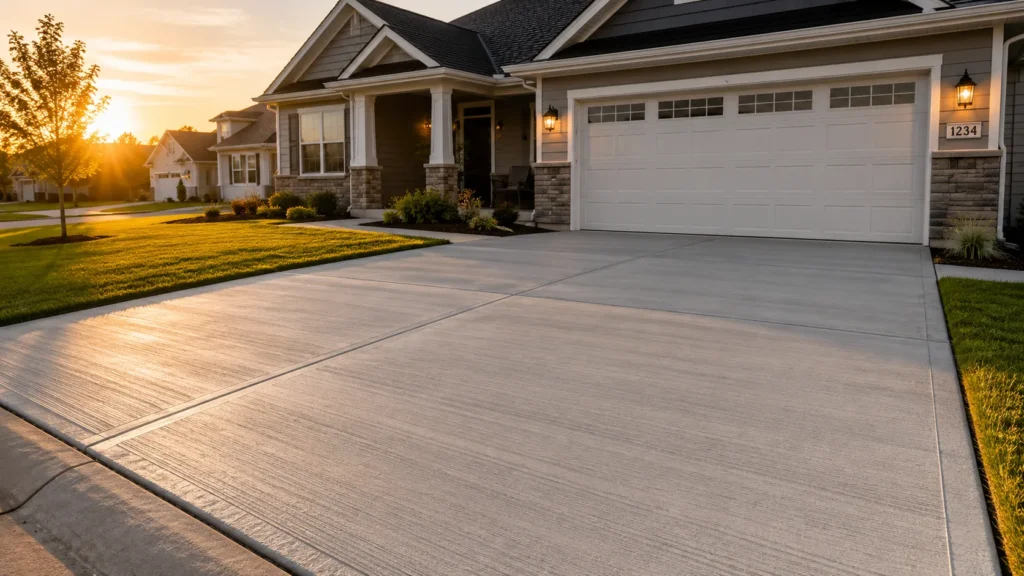
A concrete driveway costs $6 to $20 per square foot installed, with most homeowners paying $4,800 to $14,400 for a standard two-car driveway (600–800 sq ft). Basic broom-finish concrete sits at the low end of that range; stamped or decorative finishes push it toward the top.
That’s a wide range, and the reason is simple: finish, thickness, site conditions, and where you live each move the number independently. This guide breaks down every variable, shows how concrete compares to asphalt over the long run, and includes a calculator that builds an estimate around your specific driveway.
Concrete Driveway Cost by Size
Cost scales directly with square footage, though larger driveways get a slightly better per-square-foot rate since mobilization and setup costs are fixed.
| Driveway Size | Sq Ft | Estimated Cost (Basic Finish) | Estimated Cost (Stamped/Decorative) |
|---|---|---|---|
| Single-car (short) | 200 | $1,200 – $2,000 | $2,400 – $4,000 |
| Single-car (standard) | 400 | $2,400 – $4,000 | $4,800 – $8,000 |
| Two-car (standard) | 600 | $3,600 – $6,000 | $7,200 – $12,000 |
| Two-car (large) | 800 | $4,800 – $8,000 | $9,600 – $16,000 |
| Three-car / extended | 1,000 | $6,000 – $10,000 | $12,000 – $20,000 |
Ranges reflect national averages before site prep, removal, or regional adjustments.
Concrete Driveway Cost by Finish Type
Finish is the single biggest lever on price, and it’s the one homeowners underestimate most — a stamped driveway can cost nearly double a basic one for the same footprint.
| Finish | Cost Per Sq Ft | What It Looks Like |
|---|---|---|
| Basic broom finish | $6 – $10 | Plain gray, standard non-slip texture |
| Stained / colored | $9 – $14 | Tinted concrete, no pattern |
| Exposed aggregate | $10 – $16 | Textured stone finish, decorative but not patterned |
| Stamped / decorative | $12 – $20 | Patterned to mimic pavers, brick, or stone |
Why the gap is so wide: stamping and coloring require specialized labor, stamping mats or dyes, and a sealer coat — not just more material. If budget is the priority, a basic broom finish with a sealer applied later is the most common way to keep costs down without sacrificing durability.
What’s Actually in the Price: Full Cost Breakdown
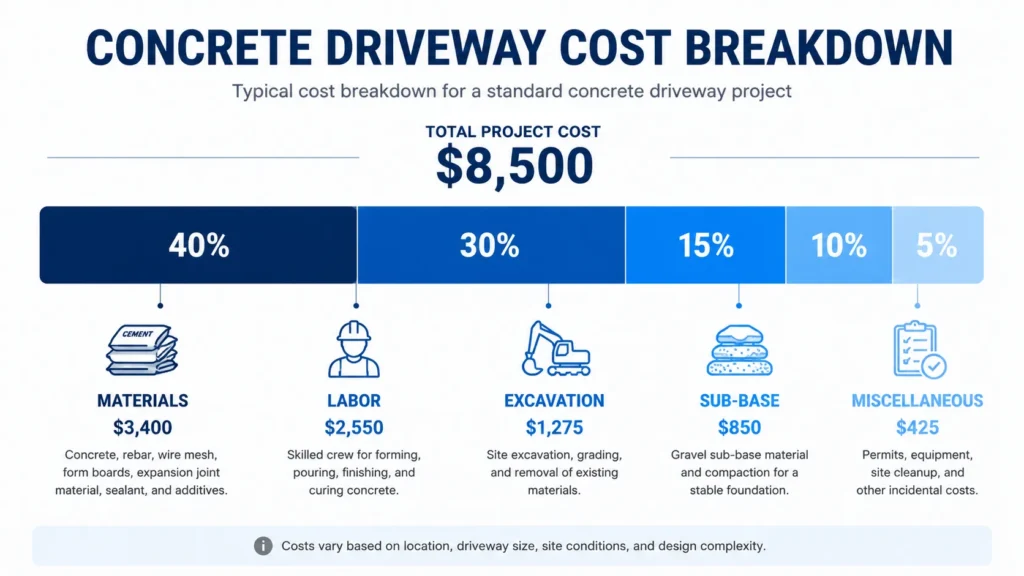
A concrete driveway quote isn’t just “concrete.” Here’s what a typical 600 sq ft project breaks down into:
| Cost Component | Typical Range | Notes |
|---|---|---|
| Materials (concrete, rebar/mesh, forms) | $2 – $5 / sq ft | Higher-strength mix (4,000+ psi) costs more but resists cracking better |
| Labor | $2 – $10 / sq ft | Often 40–50% of total project cost |
| Excavation & grading | $1 – $3 / sq ft | Increases with slope or poor soil |
| Sub-base / gravel prep | $1 – $3 / sq ft | Skipping this is the #1 cause of cracking and settling |
| Old driveway removal | $2 – $6 / sq ft | Only applies to replacements |
| Permit | $50 – $500 | Most cities require one for new installs or replacements |
A note on labor: because labor is often the largest line item, two quotes for the “same” driveway can differ by thousands of dollars based purely on crew experience and local demand — not material choice. Getting three written quotes is the single best way to sanity-check a bid.
Concrete vs. Asphalt Driveway Cost
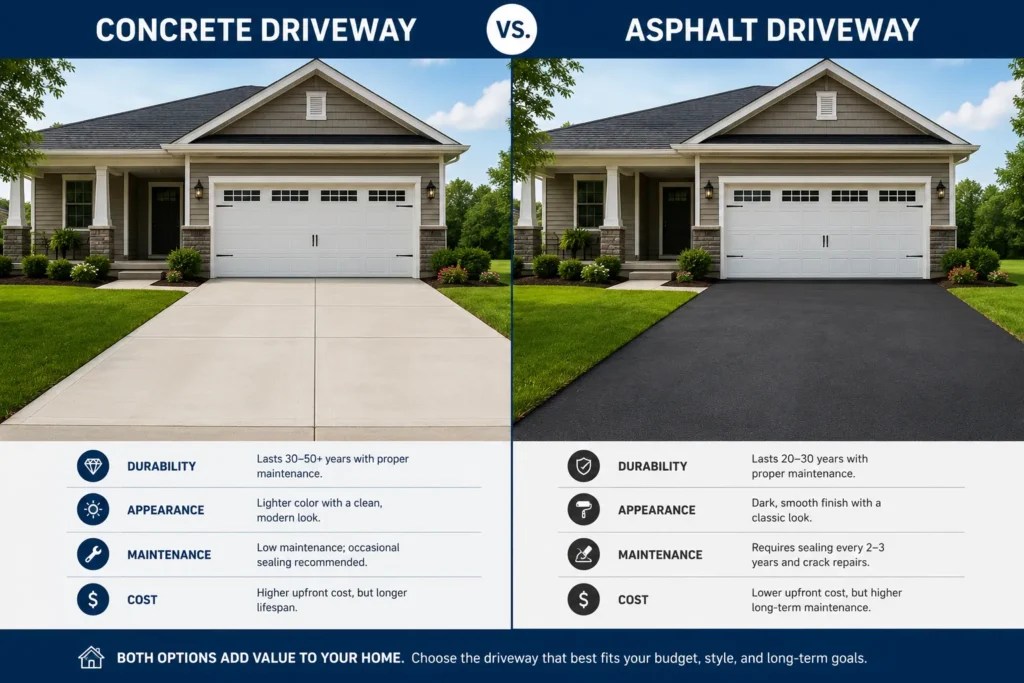
This is one of the fastest-growing comparisons homeowners search for, and the upfront numbers favor asphalt — but the full picture is more nuanced.
| Concrete | Asphalt | |
|---|---|---|
| Cost per sq ft | $6 – $20 | $5 – $12 |
| 600 sq ft driveway | $3,600 – $12,000 | $3,000 – $7,200 |
| Lifespan | 25 – 40 years | 15 – 20 years |
| Maintenance | Sealing every 5–7 years (optional) | Sealcoating every 2–3 years (required) |
| Climate fit | Better in hot climates; can crack in severe freeze-thaw without proper base | Better in cold climates; flexes with freeze-thaw cycles |
| Repair cost | $3 – $25 / sq ft (patch to major) | $1 – $5 / sq ft (patch to major) |
| Customization | Stamping, staining, exposed aggregate | Limited to black; some tinting available |
The real question isn’t which costs less today — it’s which costs less over 20-plus years. Asphalt is 30–40% cheaper to install, but its shorter lifespan and mandatory sealcoating schedule close much of that gap by year 15–20. If you’re staying in the home long-term, concrete’s durability tends to win out. If you’re optimizing for the lowest upfront cost or live somewhere with harsh winters, asphalt remains the more practical choice.
Concrete Driveway Repair & Resurfacing Cost
Not every concrete driveway needs full replacement. Repair and resurfacing costs vary widely based on severity:
- Minor crack repair: $3 – $8 per sq ft (or per linear foot for isolated cracks)
- Resurfacing / overlay: $3 – $7 per sq ft — a new thin layer poured over the existing slab, viable if the base is still structurally sound
- Major repair (sinking, large sections): $15 – $25 per sq ft, approaching replacement cost
As a rule of thumb: if damage covers more than 25–30% of the surface, or the sub-base has failed, full replacement is usually more cost-effective than repeated patching.
Regional Cost Variations
Location moves concrete driveway pricing by 20–30% in either direction from the national average:
- Northeast / West Coast: $10 – $22 per sq ft — higher labor rates, stricter permitting, and freeze-thaw-resistant mix requirements push costs up.
- National average / Midwest: $8 – $16 per sq ft.
- South / Southeast / rural markets: $6 – $14 per sq ft — higher contractor density and lower labor costs bring prices down; Texas and Florida are consistently among the more competitive markets.
DIY vs. Hiring a Pro
Pouring a concrete driveway is one of the least DIY-friendly projects on this list. Unlike gravel or even asphalt overlays, concrete requires precise mixing, proper sub-base compaction, correctly timed finishing work, and control joints cut before the slab cures — mistakes here show up as permanent cracks. Most homeowners save 20–30% doing prep work themselves (excavation, old driveway removal) while hiring a pro for the pour and finish.
How to Save Money on a Concrete Driveway
- Stick with a basic broom finish and add color or a stamped border later if budget allows — full-slab stamping is the most expensive line item on this list.
- Handle demolition and haul-away yourself if the old driveway is accessible, cutting $2–$6/sq ft from the quote.
- Time it for shoulder season (spring or fall) — contractors often price summer work at a premium.
- Get three written quotes. Pricing for identical specs commonly varies 30–50% between contractors.
- Choose 4″ standard thickness unless you’re regularly parking heavy vehicles — the extra $1–$2/sq ft for 6″ isn’t necessary for typical passenger cars.
Frequently Asked Questions
How much does a concrete driveway cost? A concrete driveway costs $6 to $20 per square foot installed, or roughly $4,800 to $14,400 for a standard 800 sq ft two-car driveway, depending on finish, thickness, and region.
How much does it cost to replace a concrete driveway? Replacement costs $8 to $26 per square foot once demolition and haul-away of the old slab is included — the base installation cost plus $2–$6/sq ft for removal.
Is concrete cheaper than asphalt? No, asphalt is typically 30–40% cheaper to install upfront. Concrete costs more initially but lasts roughly twice as long and requires less frequent maintenance, narrowing the total cost gap over 20+ years.
How much does concrete driveway resurfacing cost? Resurfacing an existing driveway with a new overlay costs $3 to $7 per square foot, significantly less than full replacement — as long as the sub-base is still sound.
What’s the average cost of a concrete driveway? The average concrete driveway (standard 600–800 sq ft, basic to mid-range finish) costs $4,800 to $12,000 installed nationally, with most homeowners landing around $6,000–$8,000.
Does a stamped concrete driveway cost more? Yes — stamped concrete costs $12–$20 per square foot versus $6–$10 for a basic finish, roughly double, due to specialized labor and materials.

James focuses on building material cost research and supplier pricing analysis. He continuously updates our cost database with current quotes from manufacturers and distributors. His work ensures that homeowners have access to accurate, up-to-date pricing information for planning their projects