How Much Does It Cost to Build a Prefab House? (2026 Guide)
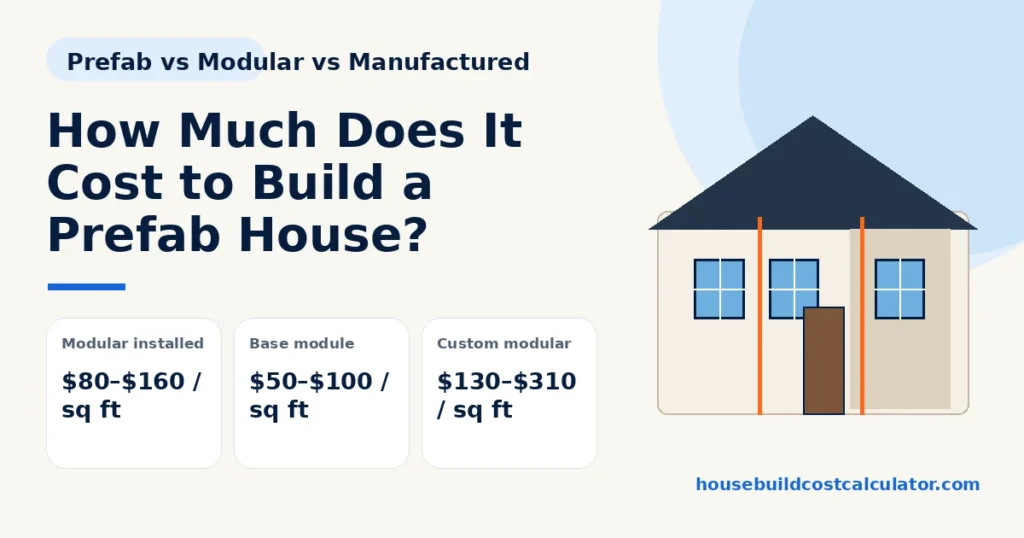
When people ask how much does it cost to build a prefab house, the word prefab causes most of the confusion. Prefabricated simply means some or most building components are produced off-site. Modular homes, manufactured homes, panelized systems, kit homes, and some tiny homes can all be called prefab, but they follow different codes, foundations, financing paths, and cost structures.
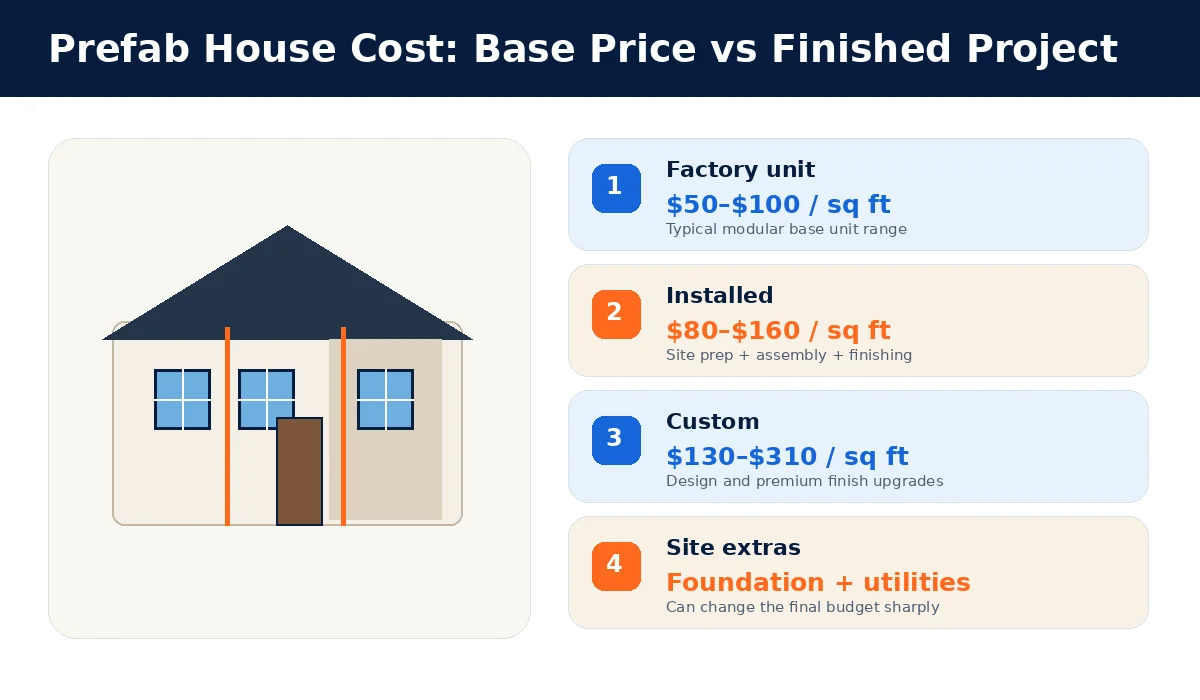
The most useful comparison is therefore not “prefab vs normal.” It is base factory price vs completed project price. A factory quote may exclude excavation, foundation, utility service, crane work, local permits, decks, garages, driveways, landscaping, taxes, and interior upgrades.
How Much Does It Cost to Build a Prefab House in 2026?
| Prefab type | Typical 2026 price | What is usually included |
|---|---|---|
| Modular — base unit | $50–$100 / sq ft | Factory-built modules; site work and finishing may be separate |
| Modular — fully installed | $80–$160 / sq ft | Site prep, foundation, setting modules, utilities and standard finishing |
| Custom modular | $130–$310 / sq ft | More design freedom and premium specification |
| Manufactured home | $60–$120 / sq ft | HUD-code factory-built home; site and installation scope varies |
| Panel / kit home | $40–$60 / sq ft for kit components | Owner or contractor still provides substantial site labor |
The ranges come from 2026 consumer construction data and should be treated as planning numbers. Transportation distance, crane access, foundation design, snow/wind loads, local labor, and finish level can move a project well outside the typical band.
Prefab vs. Modular vs. Manufactured: What Is the Difference?
Modular home
A modular home is built in large factory-made sections and assembled on a permanent foundation. It generally follows the state and local building codes that apply to site-built homes. Once completed, a modular home functions as conventional real property in many markets.
Manufactured home
A manufactured home is built under the federal HUD construction and safety standards. It is constructed on a permanent chassis and has a different regulatory framework from a modular home. That difference affects design, installation, titling, and sometimes financing.
Panelized and kit homes
Panelized systems deliver wall, floor, or roof panels rather than complete room-sized modules. Kit homes may deliver pre-cut structural components and plans. Their low material price can be attractive, but they still require site labor, foundation work, utilities, and local inspections.
Prefab House Cost by Size
Using HomeGuide’s installed modular range of about $80–$160 per sq ft gives the following planning table:
| Home size | Base modular unit | Typical finished modular cost |
|---|---|---|
| 800 sq ft | $40,000–$80,000 | $64,000–$128,000 |
| 1,000 sq ft | $50,000–$100,000 | $80,000–$160,000 |
| 1,500 sq ft | $75,000–$150,000 | $120,000–$240,000 |
| 2,000 sq ft | $100,000–$200,000 | $160,000–$320,000 |
| 2,500 sq ft | $125,000–$215,000 | $200,000–$365,000 |
Always ask the manufacturer exactly what “finished” means. Some quotes include delivery and setting but not utility trenching, septic, driveway, porch, garage, landscaping, or premium interior selections.
What Is Missing From a Prefab Base Price?
A base price can be useful for comparing manufacturers, but it is not an all-in construction budget. The site can easily become the largest source of uncertainty.
- Land preparation: clearing, grading, excavation, access road, erosion control.
- Foundation: crawl space, basement, piers, or another engineered system.
- Transportation: distance, route restrictions, escorts, permits, and delivery staging.
- Crane and set crew: site access and module size affect setup.
- Utility construction: water, sewer or septic, electrical, gas where used, communications.
- Permits and local fees: plan review, building permit, utility fees, impact fees where applicable.
- Exterior additions: garage, decks, porches, steps, driveway, landscaping.
- Interior upgrades: cabinetry, counters, flooring, lighting, appliances, plumbing fixtures.
If the project uses a concrete foundation, the Concrete Slab Cost Calculator can help isolate one foundation scenario. For a full site-built comparison, run the same size and finish through the House Build Cost Calculator so the decision is based on comparable scope rather than two different definitions of “cost.”
Does Prefab Construction Save Money?
It can, but factory construction is not automatically cheaper in every location. Savings usually come from repetitive processes, controlled indoor production, less weather downtime, bulk purchasing, and reduced material waste. Those advantages can be offset by long-distance shipping, crane access, complex foundations, difficult sites, high local finishing costs, or extensive customization.
The strongest prefab value proposition is often cost predictability and schedule control, not just the lowest possible dollar per square foot.
Prefab House Timeline
Factory work can occur while foundation and site work proceed, which is one reason modular projects can move quickly. But the entire project still depends on permits, utility approvals, factory lead times, transportation, foundation completion, weather at the set date, and local finish crews. A “house built in weeks” claim usually describes factory production, not the full process from land purchase to move-in.
Financing and Resale: Modular vs. Manufactured
Modular homes on permanent foundations are generally treated more like site-built homes because they follow state/local building codes. Manufactured homes follow the federal HUD code and can have different titling and financing rules. If conventional mortgage treatment or future resale is important, confirm the classification with the lender, appraiser, manufacturer, and local jurisdiction before signing a contract.
How to Compare Prefab Quotes Correctly
- Ask for the base unit price and the complete installed price separately.
- Confirm whether delivery, crane, taxes, foundation, utility hookups, and permits are included.
- Compare the same finish specification: windows, cabinets, counters, flooring, HVAC, fixtures, and appliances.
- Ask who is responsible for local inspections and punch-list corrections.
- Check the transportation radius and oversized-load assumptions.
- Keep a site contingency even if the factory price is fixed.
Frequently Asked Questions
How much does a 1,500 sq ft prefab house cost?
A 1,500 sq ft modular home is commonly around $75,000–$150,000 for the base unit and roughly $120,000–$240,000 for a typical finished installation, before unusual site conditions or premium customization.
Is a modular home the same as a manufactured home?
No. Modular homes generally follow state and local building codes and are assembled on permanent foundations. Manufactured homes are built under the federal HUD code on a permanent chassis.
Are prefab homes always cheaper than site-built homes?
No. Factory efficiency can reduce cost and schedule risk, but transport, site work, foundation complexity, and customization can erase the difference.
Does the prefab price include land?
Usually not. Land purchase should be treated as a separate cost unless a specific turnkey development contract says otherwise.
Sources and Methodology
- HomeGuide — Modular Home Prices (2026)
- Angi — Prefab Home Cost (2026)
- U.S. Census Bureau — Manufactured Housing Survey
- HUD — Manufactured Home Construction and Safety Standards
- Rocket Mortgage — Modular Home Prices

Sarah specializes in home renovation budgeting and cost breakdown analysis. She reviews contractor pricing, material specifications, and building material trends across different regions. Her editorial work focuses on ensuring our calculators reflect current market conditions and building practice standards.