How Much Does It Cost to Build a Shed House? (2026 Guide)
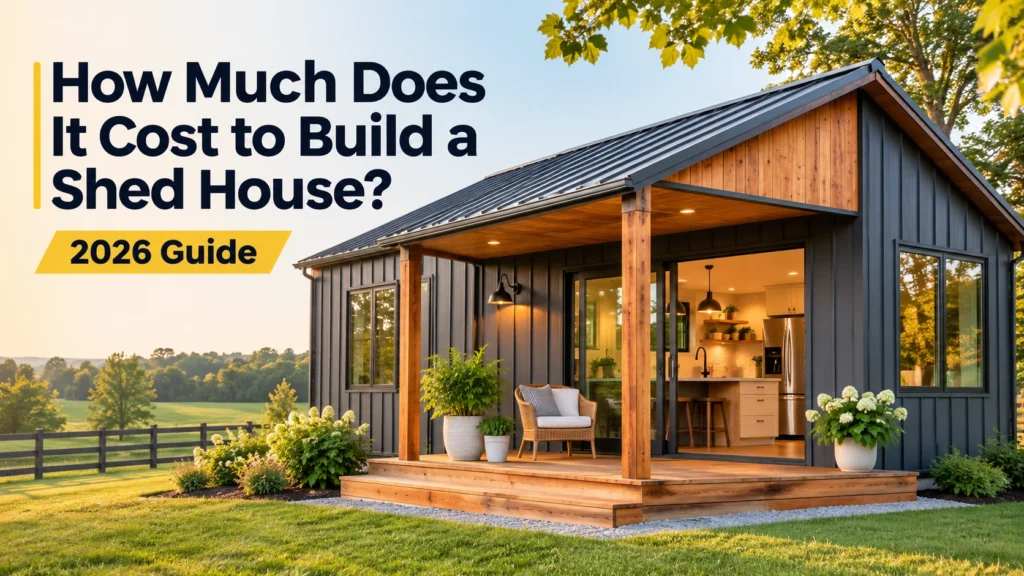
The cost to build a shed house depends on three things you can price separately: the building, the work to finish the interior, and the work to connect it to your land. For a 16 × 32 ft building, one Kansas supplier lists $21,000 for an uninsulated cabin shell or $58,000 finished with a bedroom, kitchenette, bathroom, and heating and cooling. That leaves $37,000 between the two packages. You still need to establish what it will cost to place and connect the building on your property. ProjectivePortableBuildings.com
If you already own a shed, your starting point is different. Before pricing cabinets or flooring, ask your local building department whether the structure can be approved as a dwelling. Finding out that the foundation needs replacing can change the decision more than any interior finish you choose.
Shed House Cost by Size
The table compares uninsulated and finished cabins from Projective Portable Buildings in Newton, Kansas. These are useful benchmarks for someone shopping for a shed-style home because both prices come from the same supplier for the same footprint. All prices are in U.S. dollars. ProjectivePortableBuildings.com
| Building size | Footprint | Uninsulated shell | Finished cabin | Difference |
|---|---|---|---|---|
| 16 × 24 ft | 384 sq ft | $16,500 | $44,600 | $28,100 |
| 16 × 32 ft | 512 sq ft | $21,000 | $58,000 | $37,000 |
| 16 × 40 ft | 640 sq ft | $24,500 | $70,000 | $45,500 |
| 16 × 50 ft | 800 sq ft | $31,500 | $85,000 | $53,500 |
What does that cost per square foot? Dividing each finished price by its listed footprint gives approximately $106–$116 per sq ft across these four models. Use that range to compare building packages. The supplier’s listing does not establish the total cost of land, site work, utility connections, or approval for residential use at your address. Supplier prices and package descriptions
How Much Does It Cost to Build a Shed House After the Shell?
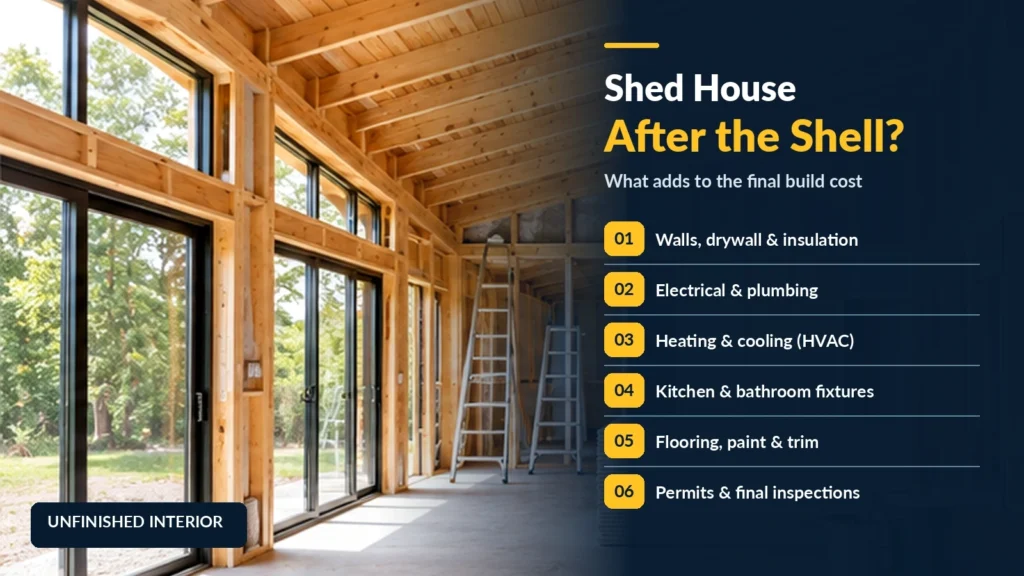
For the 512 sq ft example, the supplier charges $37,000 more for its finished package than for its shell. That gives you a useful number when comparing two options: buying the finished building or purchasing the shell and hiring local trades. If you choose the shell, get written prices for the following work before deciding which option costs less. ProjectivePortableBuildings.com
| Work to price | What to ask the contractor |
|---|---|
| Insulation and interior walls | Does the quote cover the floor, walls, and roof, plus the finished wall and ceiling surfaces? |
| Electrical and plumbing | Does it cover wiring, outlets, water lines, drains, and the water heater? Where does the contractor’s work stop? |
| Heating, cooling, and ventilation | Are the equipment, installation, and bathroom exhaust included? |
| Kitchen and bathroom | Which cabinets, counters, appliances, shower, toilet, and sink are included? Who installs them? |
| Flooring and trim | Does the price include subfloor repairs, finished flooring, paint, trim, and installation? |
| Plans, permits, and inspections | Who applies, who pays the fees, and who handles corrections if an inspection identifies a problem? |
One question can prevent a costly misunderstanding: “When you say plumbing is included, does that end at the building wall or include the connection to my water and sewer lines?” Ask the same question about electrical service. A finished bathroom still needs working connections on your lot.
What one homeowner actually spent on a shed conversion
A Texas homeowner documented a 640 sq ft shed-to-house conversion completed in 2019. They reported paying about $16,000–$17,000 for the shed after paying off a rent-to-own agreement early and approximately $20,000 to finish it, bringing their reported total to around $37,000. The finishing work included electricity, plumbing, flooring, drywall, fixtures, and cabinetry. The owner also describes choosing inexpensive materials. This is a historical owner-reported budget, useful for seeing where the money went rather than setting a current contractor rate. Homeowner’s shed conversion cost breakdown experttexan.com
Foundation, Delivery, and Utility Costs
Two buyers can order the same building and end up with different totals. One may have a level site with services close by. Another may need excavation, a longer electrical run, or a septic system. Give contractors the building dimensions and a site sketch so they can price the work for your property.
- Foundation and ground preparation. Ask for a price covering excavation, drainage, the foundation specified for your building, and anchoring. If you already own the shed, ask whether its existing supports can be reused. House Foundation Cost Guide
- Delivery and placement. Measure the narrowest gate or driveway opening and tell the supplier about turns, slopes, and overhead obstructions. In one documented Texas project, a family’s 16-foot-wide shed would not fit through their 15-foot gate, so they paid to have it built on site. tinyhometours.com
- Water, wastewater, and power. Ask installers to price the route from the connection point to the building. Give them the approximate distance and identify any paving that must be removed and restored.
- Land and fees. If you are buying a parcel, show its price on a separate line. Add applicable design, permit, connection, and inspection fees once you know which ones your quotes cover.
For your own budget: Start with your chosen building package. Add only the unfinished work, site costs, and fees missing from that package. For example, if you select the $58,000 finished cabin, the $37,000 finishing difference is already inside that price. Adding it again would count the interior twice. ProjectivePortableBuildings.com
Can You Legally Turn a Storage Shed Into a House?
Before paying a deposit, give your local planning or building department the property address, shed dimensions, and intended use. Be specific about whether this would be the only home on the land or a second dwelling behind an existing home. Ask which approval applies.
For example, Portland, Oregon, allows an existing accessory structure to be considered for conversion into an accessory dwelling unit (ADU). The city requires building and trade permits for an ADU project and identifies ceiling height, emergency exit windows, insulation, and ventilation as potential obstacles. Your local department can tell you which requirements apply to your property. City of Portland’s ADU conversion guidance Portland.gov
Before buying a shell, get answers to three questions:
- From the planning department: Can I use this building as a year-round dwelling on this parcel?
- From the supplier: Can you provide the floor, wall, roof, and foundation drawings the reviewer needs for this model?
- From the contractor: What must change for this specific shell to qualify, and how much will those changes cost?
Shed Conversion or Purpose-Built Tiny House?
A shed conversion is worth pricing when you already own a suitable shell, the layout fits the rooms you need, and a contractor can quote the remaining work. If you are buying the shell new, ask for a purpose-built small-home quote at the same time. Give both bidders the same floor area, bathroom, kitchen, foundation, and utility connection points. That makes their totals comparable. Tiny House Cost Guide
The deciding number is what you still have to pay before you can use the home. On an existing shed, that might mean a new foundation and a complete interior. On a finished cabin, it might mean delivery, hookups, and local approvals. Put those remaining costs beside each offer before choosing.s residential conversion.