Is It Cheaper to Build or Buy a House? The Real Numbers in 2026
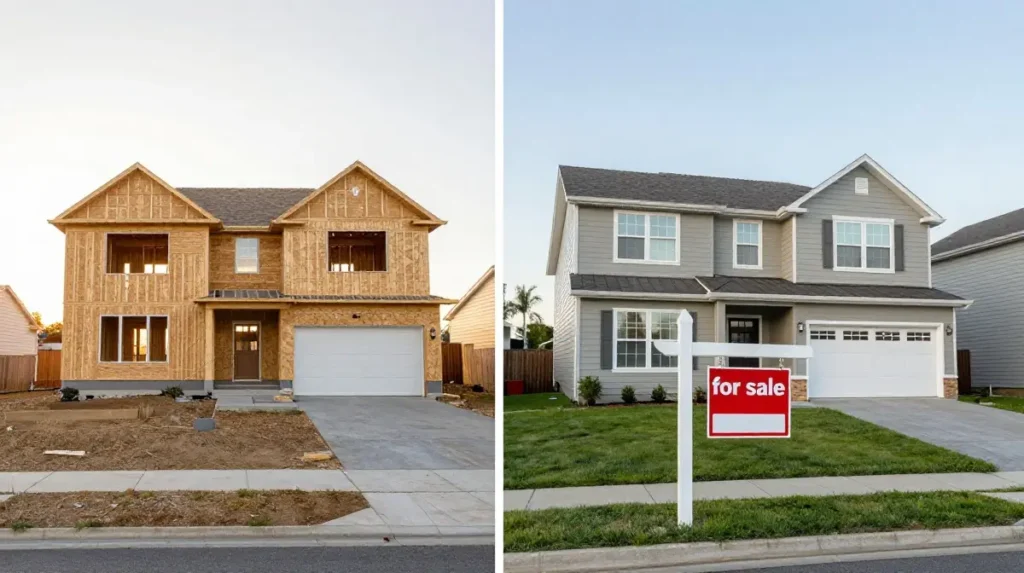
For most of the last decade, the answer to “is it cheaper to build or buy a house” was a straightforward “buying.” New construction carried a real premium — as high as 37% over existing homes back in 2015. That gap has been quietly closing for years, and in the first quarter of 2026, it flipped entirely: the median new single-family home sold for $403,200, about $1,400 less than the median existing home at $404,600, according to Census Bureau and NAR data. That’s the fourth straight quarter new homes have priced below resale.
That single data point doesn’t settle the question — land cost, timeline, and your local market still swing the math hard in either direction. This guide breaks down the real, all-in cost of each path so you can run the comparison for your own situation instead of relying on a national average.
Quick answer: Nationally, building and buying are now priced closer than they’ve been in over a decade — new construction is even pricing slightly below resale in some 2026 data. But “cost per square foot” numbers rarely include land, carrying costs, or near-term repairs, so the real answer depends on your lot cost, your local new-construction premium, and how long you plan to stay. Run your numbers through our Home Build Cost Calculator to see where you land.
Build vs. Buy: Why the Answer Isn’t What You Think
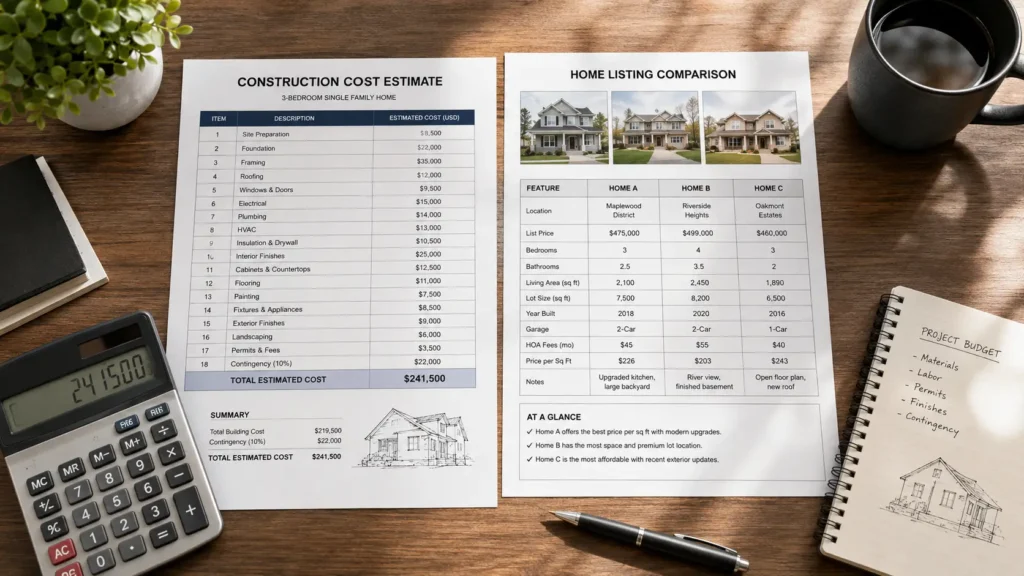
Most build-vs-buy comparisons stop at “cost per square foot to build” vs. “median home price” — two numbers that aren’t actually measuring the same thing. One is a construction cost; the other is a market price that already includes land, builder profit, and whatever the seller could get for it.
The hidden costs people forget when comparing build vs. buy
On the building side, people forget:
- Land purchase and lot prep (often the single biggest missing line item)
- Two sets of closing costs if you use a separate construction loan and permanent mortgage
- Rent or a second mortgage payment during the 7–18 month build
- Permits, impact fees, and utility hookups
- A 10–20% contingency for material and labor price swings
On the buying side, people forget:
- Closing costs, typically 2–5% of the loan amount
- Home inspection findings that turn into near-term repair bills
- Aging major systems (roof, HVAC, water heater) that weren’t priced into the sale
- Renovation costs to bring an older home to the finish level you actually want
Neither side is “free” once you look past the headline number — which is exactly why the comparison has to be done line by line, not sticker price to sticker price.
How current lumber and labor markets skew the comparison
Building costs move with commodity and labor markets in a way that a fixed purchase price doesn’t. Skilled-trade labor shortages have kept construction wages elevated and timelines longer, and material costs for concrete, steel, and copper continue to swing with supply conditions. That volatility gets priced into your contingency line — it’s a real cost of building that a resale purchase, at a fixed contract price, simply doesn’t carry. It also means “cost to build” estimates go stale faster than home listing prices do, so always price your build against current-quarter numbers, not a figure you saw a year ago.
True Cost of Buying an Existing Home
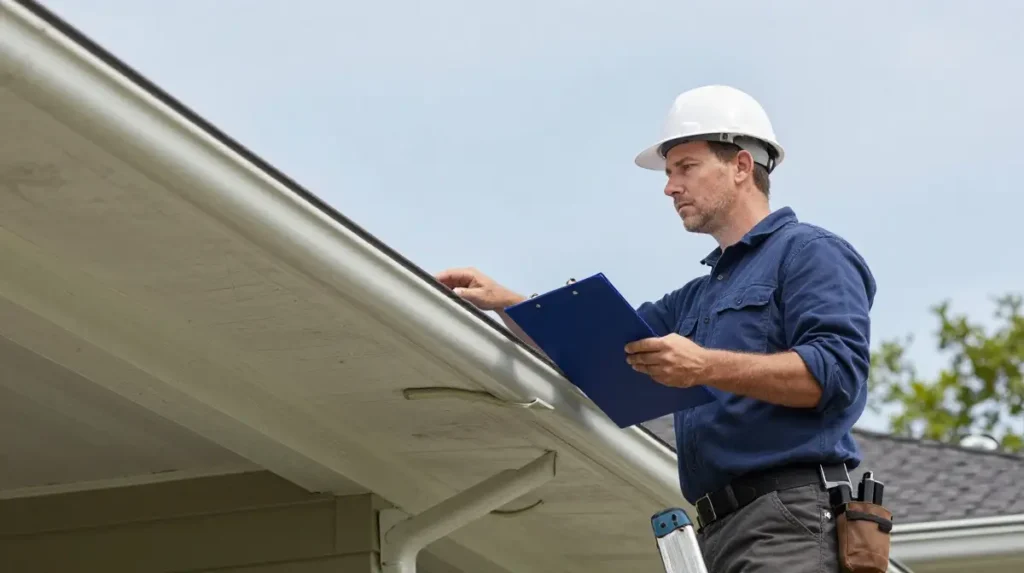
Purchase price vs. all-in cost after closing fees and renovations
The listing price is the starting point, not the total. Budget for:
- Closing costs: roughly 2–5% of the loan amount (title, lender fees, escrow, taxes)
- Immediate repairs: whatever the inspection turns up — even move-in-ready homes commonly need $2,000–$10,000 in near-term fixes
- Finish-level gap: if the kitchen or bathrooms aren’t what you want, budget renovation cost on top of purchase price — this can close much of the “buying is cheaper” gap fast
How quickly do existing homes need major systems replaced?
This is the cost buyers underprice most often. Major systems have a finite lifespan, and a home’s age tells you how close you are to a five-figure bill:
| System | Typical Lifespan | Replacement Cost |
|---|---|---|
| Asphalt shingle roof | 20–30 years | $6,600–$15,000+ |
| HVAC (furnace/AC) | 15–20 years | $5,000–$15,000 |
| Water heater (tank) | 8–12 years | $1,000–$3,500 |
| Electrical panel | 25–40 years | $1,300–$4,000 |
Before comparing a resale listing to a new-build cost, check the age of these four systems. A home priced $30,000 below a comparable new build can lose that entire advantage if the roof and HVAC are both past year 18.
Opportunity cost: what you give up waiting to build
Buying gets you into a home now — building typically takes 7–18 months from breaking ground to move-in, plus months of design and permitting before that. During that window, a buyer is already building equity and locked into a rate, while someone building is often still paying rent or a current mortgage on top of their construction loan. If rates rise during your build, or your target neighborhood appreciates while you’re still in permitting, that’s a real cost of the wait — even though it never shows up on a construction budget spreadsheet.
True Cost of Building a New House
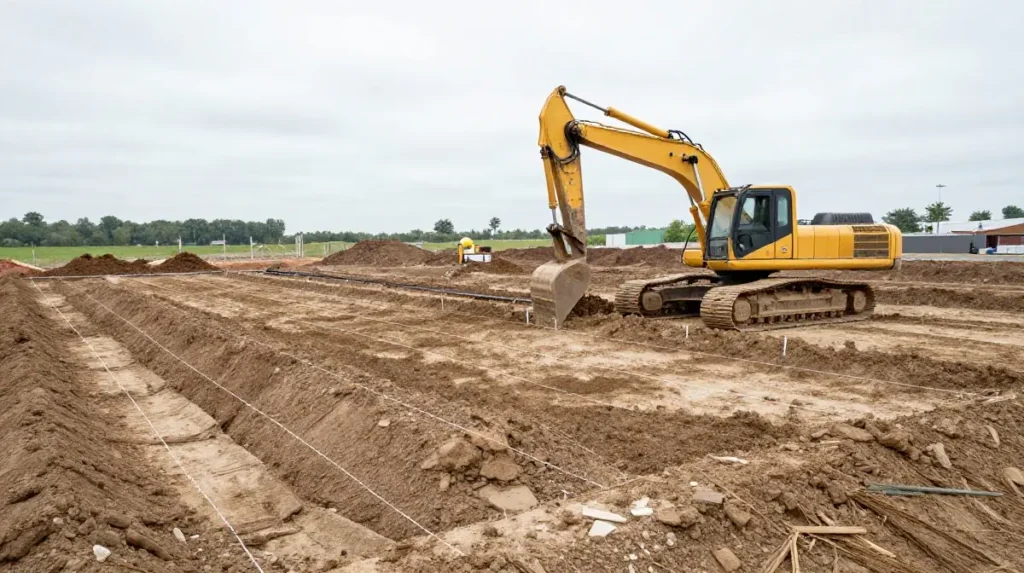
Land purchase + lot prep costs most comparisons ignore
Almost every “cost per square foot to build” figure excludes the land — which is exactly why so many people are shocked when their all-in number comes in far above the number they budgeted from. Lot prices range from about $15,000 in low-cost rural markets to $300,000+ in high-demand metros, and lot prep (grading, utility hookups, driveway) commonly adds another $3,000–$30,000 depending on how far the site is from existing utilities. Add these before you compare anything to a resale listing price — our Home Build Cost Calculator lets you plug in land cost separately so it’s not buried in a per-square-foot average.
Time = money: carrying cost during construction
Construction loans are typically interest-only during the build, charged only on funds actually drawn — but they carry higher rates than a standard mortgage because the lender is financing a home that doesn’t exist yet. Stack that on top of rent or your current mortgage, and a 10–14 month build can easily add $10,000–$30,000 in carrying costs that a resale purchase never incurs, since a resale buyer starts one mortgage payment on day one instead of two overlapping payments for over a year.
What a custom build actually gives you for the premium
Where building does cost more, it’s often buying you real, quantifiable things:
- Lower utility bills — new-construction efficiency standards can save $500–$1,200/year versus a 1980s-era home of similar size
- Builder warranties — commonly 1-year workmanship, 2-year systems, and 10-year structural coverage, versus “as-is” on most resale purchases
- Zero deferred maintenance — no aging roof or HVAC system counting down in the background
- Exact finish level and layout — no compromise line items, no “we’ll renovate that later”
Do New Build Houses Lose Value?
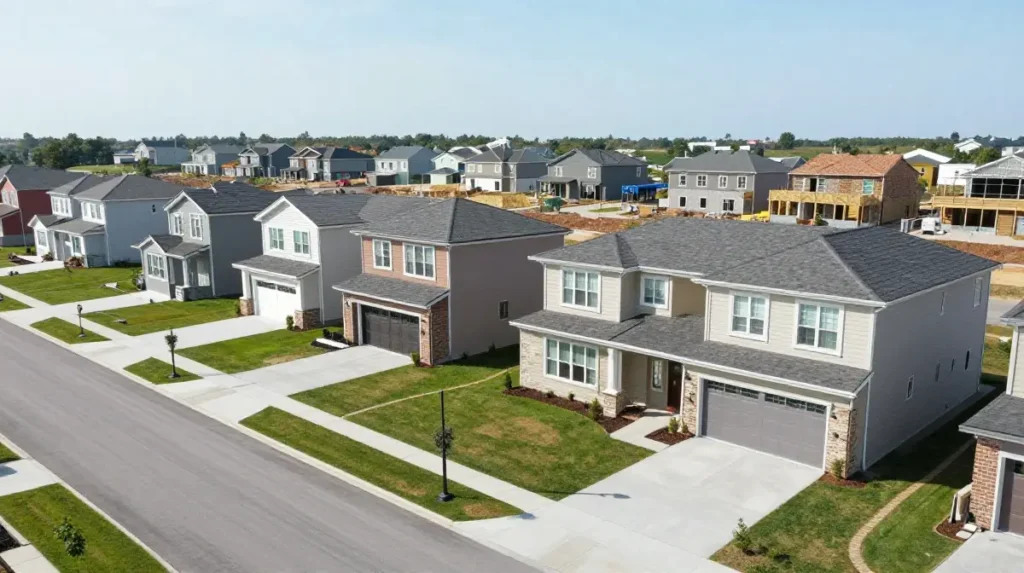
New build depreciation vs. appreciation data
New homes don’t “lose value” in any structural sense, but historically they have appreciated a bit slower than existing homes in aggregate — largely because buyers paid a premium going in, and that premium takes time to be absorbed by the market. Federal Housing Finance Agency data shows overall home prices have averaged roughly 4.0% annualized appreciation over 20 years, while one detailed sample of new-construction resales came in closer to 2.8% annualized over the same window. That’s a real gap, but it’s a legacy of an era when new homes carried a much larger upfront premium than they do now.
Why new builds in some markets outperform resale
The premium that used to explain slower new-build appreciation has largely evaporated. As of Q2 2025, the national new-construction premium over existing homes hit a record low of about 7.8%, and by Q1 2026 it had gone negative nationally. In fast-growing Sun Belt metros, some new-construction prices actually fell year over year as builders competed hard on affordability — meaning buyers there paid little to no premium to begin with, which removes the main historical drag on new-build appreciation.
What makes a new build hold its value long-term
- Let the neighborhood mature. The first 2–3 years in a new development can see slower appreciation while you’re still competing with the builder’s unsold inventory next door.
- Location still dominates. Schools, commute times, and employment centers matter as much for a new build as for a resale.
- Stick to broadly appealing finishes. Highly personalized upgrades rarely return their cost at resale — builder-grade-plus choices hold value better than niche ones.
- Buy where premiums are already low. A market with a small (or negative) new-construction premium has less “air” to work off before appreciation starts compounding normally.
When Building Wins (And When Buying Wins)
Markets where building is clearly cheaper per sq ft
New construction currently offers the best relative value in high-growth Sun Belt markets — Texas, Florida, and similar South/West metros — where builders have leaned hardest into affordable, entry-level product to keep sales moving. In some of these metros (Austin among them), new-construction list prices have actually dropped year over year even as resale prices held steady, narrowing or reversing the traditional new-build premium.
Scenarios where buying an existing home beats building
Buying tends to win when:
- You need to move within a few months, not a year-plus
- You want an established, walkable neighborhood with limited buildable land
- You’re drawn to architectural character that isn’t replicated in new construction
- Your timeline in the home is short enough that a 5–7 year break-even window doesn’t work in your favor
- Local existing-home prices have softened while material costs keep new-build pricing firm
The break-even timeline: how long until a new build pays off
Any home purchase — built or bought — typically needs 5–7 years before appreciation and equity outweigh transaction costs like closing fees, commissions, and (for a build) carrying costs during construction. That timeline used to be longer for new construction specifically, because buyers were working off a much larger upfront premium. With that premium now near zero or negative in much of the country, building no longer starts from as deep a hole — but the standard 5–7 year minimum hold period still applies before either path reliably pays off.
Build vs. Buy Decision Framework
5 questions to ask before deciding
- How long do you plan to stay? Under 5 years generally favors buying; 7+ years narrows or erases building’s disadvantage.
- Can you tolerate a 7–18 month timeline, including wherever you’ll live and what you’ll pay in the meantime?
- What’s your local new-construction premium right now — is it near the current record-low national average, or still elevated?
- Do you already own the land, or does lot cost eat into any “savings” from building?
- Do you need a specific layout or finish level that resale inventory in your area doesn’t offer?
How to run a side-by-side cost comparison for your market
- Pull 3–5 comparable active or recently sold listings in your target area, size, and finish level for the “buy” side of the comparison.
- Run your target square footage, region, and finish level through the Home Build Cost Calculator for the “build” side — see our full walkthrough in How to Calculate Cost of Building a House if you want to build the number manually first.
- Add land cost to the build total if you don’t already own a lot.
- Add closing costs and likely near-term repair costs to the buy total, checking the age of the roof, HVAC, and water heater against the lifespan table above.
- Add estimated carrying costs (rent or your current mortgage during construction) to the build total.
- Compare the two true, all-in totals — not the listed price against a bare cost-per-square-foot figure.
Building in the UK? The Math Runs Differently
If you’re comparing build vs. buy in the UK, the numbers work in your favor more consistently than in the US right now: self-build projects typically run 10–30% cheaper than buying an equivalent new-build from a developer, once land cost is factored in. Two UK-specific advantages widen that gap further — new-build materials qualify for VAT reclaim under HMRC’s DIY Housebuilders Scheme, and Stamp Duty Land Tax is paid on the (usually lower) plot price rather than the finished home’s value. The trade-off is the same as in the US: self-build mortgages release funds in stages, and you’ll likely need 9–18 months of alternative housing while the build is underway.
Frequently Asked Questions
Is it cheaper to build or buy a house in 2026? Nationally, the two are closer in price than they’ve been in over a decade — new-construction homes have priced at or slightly below existing homes in recent quarters. The right answer for you still depends on land cost, your local market’s new-construction premium, and how long you plan to stay.
Why were new homes so much more expensive than existing homes historically? New construction has traditionally carried a premium for modern finishes, energy efficiency, and warranties — as high as 37% in 2015. Builders have compressed that premium in recent years by offering smaller, more affordable product, especially in fast-growing Sun Belt markets.
Do new-build homes lose value after you move in? No — new homes don’t structurally lose value the way a car does. Historically they’ve appreciated slightly slower than existing homes because buyers paid a premium upfront, but with that premium now near zero in much of the country, the gap has largely closed.
How long should I plan to stay in a home before building makes financial sense? Plan on at least 5–7 years for either a build or a purchase to clear transaction costs and start compounding equity. Building historically needed longer to break even, but a shrinking new-construction premium is closing that gap.
Key Takeaways
- The traditional “buying is always cheaper” answer no longer holds nationally — new-construction prices have matched or dipped below existing-home prices in recent 2026 data.
- Compare all-in totals, not headline numbers: add land and carrying costs to a build estimate, and closing costs plus near-term system replacements to a buy estimate.
- Check the age of a resale home’s roof, HVAC, and water heater before assuming it’s the cheaper option — these can add tens of thousands in near-term cost.
- New construction currently offers the best relative value in high-growth Sun Belt markets like Texas and Florida, where builders have pushed pricing down to stay competitive.
- Budget on a 5–7 year minimum hold period before either path clearly pays off.

James focuses on building material cost research and supplier pricing analysis. He continuously updates our cost database with current quotes from manufacturers and distributors. His work ensures that homeowners have access to accurate, up-to-date pricing information for planning their projects
One Response