How Much Does It Cost to Build a Custom House? (2026 Guide)
How much does it cost to build a custom house? For a 2026 planning budget, a practical national range is roughly $280–$450+ per square foot for many custom homes, with very simple or lower-cost-market projects below that band and architecturally complex luxury homes well above it. At 2,000 sq ft, that means about $560,000–$900,000+ for construction before land and major site work.
Cost to Build a Custom House by Size in 2026
| Home size | Planning range at $280–$450+/sq ft |
|---|---|
| 1,500 sq ft | $420,000–$675,000+ |
| 2,000 sq ft | $560,000–$900,000+ |
| 2,500 sq ft | $700,000–$1,125,000+ |
| 3,000 sq ft | $840,000–$1,350,000+ |
| 4,000 sq ft | $1,120,000–$1,800,000+ |
The $280–$450+ band aligns with HomeGuide’s current custom-home ranges. Angi’s 2026 custom-home guide reports an even wider $200–$550 per-square-foot span, which shows why location and specification must be stated alongside any custom-home number.
Custom vs. Semi-Custom vs. Production Home Costs
| Build type | Design freedom | Typical cost behavior |
|---|---|---|
| Production / builder-grade | Preset plans and options | Lowest design cost; repetition improves purchasing and labor efficiency. |
| Semi-custom | Modify an established plan | Middle ground; fewer one-off details and less design time than full custom. |
| Fully custom | Site-specific plan and specification | More architecture/engineering, unique details, custom procurement and change-management risk. |
The House Build Cost Calculator can compare custom, semi-custom, builder-grade and modular approaches. The sections below explain why a fully custom project can move outside a standard range and which design decisions have the greatest effect on the budget.
Where the Custom Home Budget Goes
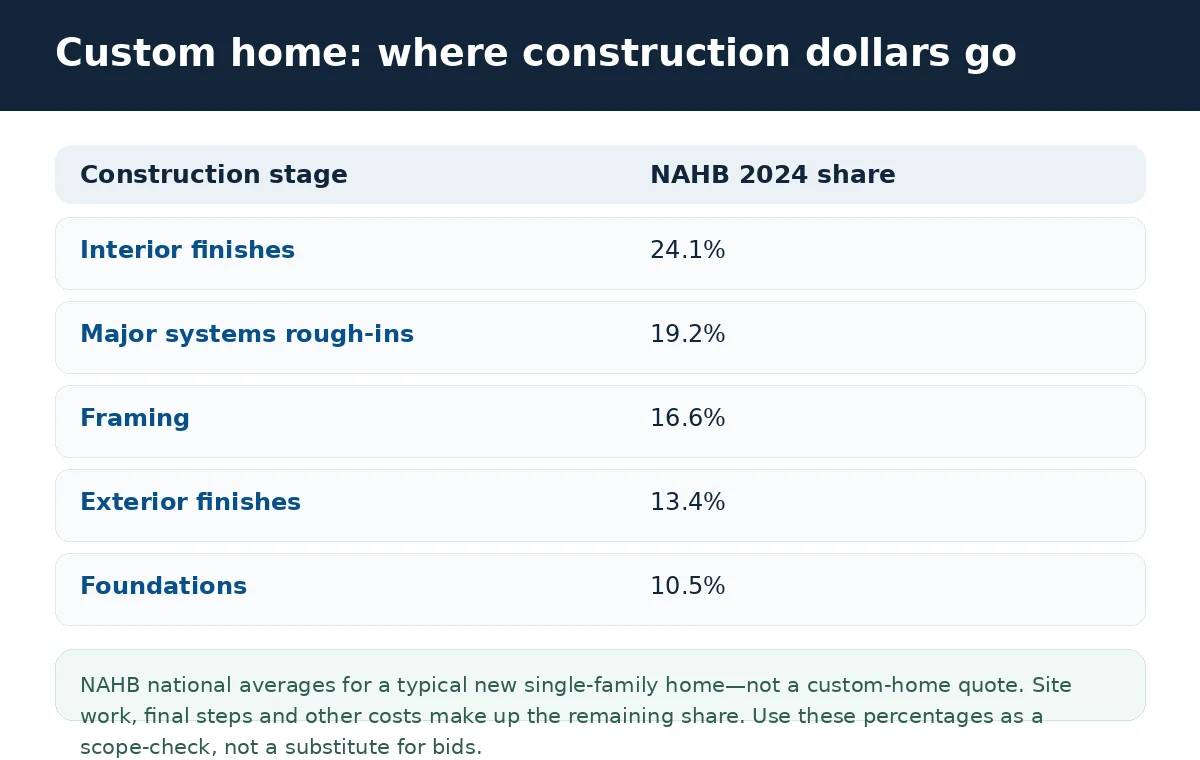
NAHB’s 2024 Cost of Constructing a Home survey is not a custom-home price guide, but it is useful as a scope audit. Across the survey’s typical new single-family homes, construction dollars were distributed approximately as follows:
- Interior finishes: 24.1%
- Major system rough-ins: 19.2%
- Framing: 16.6%
- Exterior finishes: 13.4%
- Foundations: 10.5%
- Site work: 7.6%
- Final steps: 6.5%
- Other: 2.1%
See the NAHB 2024 study. A custom home can shift these percentages substantially—for example, a high-end interior package can push finishes far above the national share—but the list is a good way to catch missing scope.
Why Custom Home Cost per Sq Ft Varies So Much
NAHB’s analysis of Census Survey of Construction data reported a $166 per square foot median for contractor-built single-family homes started in 2024. That is real national data, but it is not the same thing as a 2026 retail quote for a high-spec custom home. The dataset includes regional variation and a wide range of contractor-built projects; consumer cost guides often emphasize projects with more customization and finishes. Read NAHB’s regional square-foot analysis for the underlying context.
The right lesson is not to pick the lowest source. It is to match the source to your project’s location, scope, design level and exclusions.
7 Decisions That Increase Custom Home Costs
1. Site and foundation
A custom design should respond to the lot. Steep slopes, poor soil, flood constraints, retaining, long utility runs and difficult access can consume budget without adding living area.
2. Building shape
More corners, roof intersections, cantilevers and double-height spaces mean more structure and exterior envelope per square foot. A compact plan usually buys more finish quality for the same total budget.
3. Window and door package
Large-format glazing is one of the easiest ways to move from “custom” to “luxury-custom.” It affects product cost, structural openings, flashing, lifting and sometimes HVAC load.
4. Kitchen and bathrooms
These rooms concentrate cabinets, counters, fixtures, appliances, plumbing and electrical. A modest change in finish tier can add more than adding a simple bedroom of the same area.
5. Structural system
Wood frame, steel, ICF, CMU and hybrid systems have different local labor markets. If concrete is part of the concept, see the concrete house cost guide and compare the full wall assembly—not just the concrete material price.
6. Allowances
A low allowance does not make a project cheaper; it delays the cost until selections are made. Ask for realistic allowances tied to actual product examples.
7. Change orders
Custom projects invite decisions. Freeze structural, window, kitchen and MEP decisions before construction wherever possible. Late changes pay for demolition, rework, remobilization and schedule disruption.
How to Budget a Custom Home Before Final Drawings
- Start with size, location and target specification in the House Build Cost Calculator.
- Use the step-by-step build cost guide to list hard costs, soft costs and excluded items.
- Ask the architect/builder for a cost plan at concept, schematic and construction-document stages.
- Replace allowances with actual selections as design develops.
- Use the Raw Material Cost Calculator only where you have real quantities; do not turn a bill-of-materials tool into a whole-house estimator.
- Use the Lumber Calculator for framing quantities when the structural scheme is known.
Custom Home vs. Existing Home: Cost Trade-Offs
A custom home provides more control over site response, layout, envelope, systems and finishes, but it also adds design time, carrying cost and decision risk. When the choice is still between building and buying, compare the full project—not only construction—using the build vs. buy guide.
Frequently Asked Questions
How much does a 2,000 sq ft custom house cost?
A practical 2026 planning range is roughly $560,000–$900,000+ for construction at $280–$450+ per square foot, before land and major site work.
Is custom always more expensive than semi-custom?
Usually, because architecture, engineering and one-off details reduce repetition. But a compact custom design with disciplined finishes can cost less than a large semi-custom home loaded with upgrades.
What should be excluded from a custom-home $/sq-ft quote?
Never assume. Ask specifically about land, site work, utility extensions, design fees, permits, landscaping, driveway, appliances, financing, builder overhead/profit and contingency.
How can I reduce custom-home cost without making it builder-grade?
Keep the geometry simple, protect the building envelope and structure, standardize window sizes where possible, group plumbing, reduce late changes and spend selectively on finishes people touch and see most.
Sources
- HomeGuide — Cost to build a house (custom vs builder-grade)
- Angi — 2026 custom home cost
- NAHB — Median square-foot prices by region
- NAHB — Cost of Constructing a Home 2024

One Response